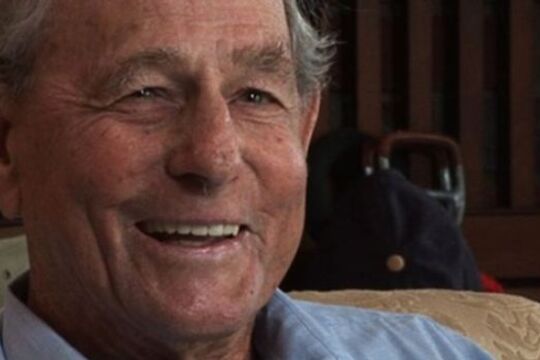
Roger was a widower with no living relatives or close friends. His life experiences placed him in both world wars and post war migration. This is his story.
Click
here to hear David Tytherleigh talk bout the process of making this story.
Further Information
Video Transcript for
The Little Frenchman
David Tytherleigh
First Person: ACMI Stories
ACMI Digital Storytelling
Australian Centre for the Moving Image (ACMI)
Roger was my neighbour. He lived across the road in a dilapidated weatherboard cottage surrounded by an over grown garden. Everyday he would stand by his front gate and watch the passing traffic, occasionally engaging in conversation with a passer-by. That’s how I got to know him that was the beginning of our friend ship. Roger had found an active listener in me and so he began to share his stories. Over time I learnt of his life experiences and why he was living alone in this cottage. His wife Jean had died in 1985 after a long illness. Her death had been traumatic and Roger recalled again and again this story to me, as he did the story of his fathers death during the Great War. Roger carried in his jacket pocket a small photo of his father given to him by his grandmother in later life. Declared an orphan of war by the French Government, Roger, aged twelve began working as a pastry cook and in 1939 prior to the outbreak of war was called up into the Army Reserve. He was captured by the Germans in 1940 and spent the next four years as a prisoner of war, escaping three times but always recaptured. Liberated in 1945, he immigrated to Australia in 1951. Roger invited me into his home and I saw firsthand the environment that he lived in. It was like time had ceased. Jeans possessions were still everywhere, the hallway wall and lounge room ceiling had collapsed, dust covered everything. Amidst all this mess Roger carried on with his life, walking to the shops in the morning for supplies, then back home for a meal, standing by the fence in the afternoon, then off to bed. This was his daily routine seven days a week. It became evident there hadn’t been any outside support or activity in Rogers life for years. Over the next two years our conversations remained the same; it was becoming clear that Roger was slowly becoming senile. Illness forced Roger into hospital and then into a nursing home. He was never to return to his cottage. This was sold, then demolished and made into a car park. Fortunately he was never to know this.
On Sundays I would visit him and we would sit and play cards, listen to Edith Piaf sing and eat little coloured marshmallows. Sometimes we just sat in silence and held hands. In Rogers’s house I had found a box of old photographs but the places, persons and times captured were now unknown to him, the memories and stories had all been lost. Rogers’s health steadily declined, his spirit was fading, he said it was time to die. He died quietly one Wednesday afternoon at around five o’clock. Three people attended his funeral. I feel as a community we let Roger down, that the service that he had given in his younger life was not returned to him in his later years. He had stories to tell and share, this is his.