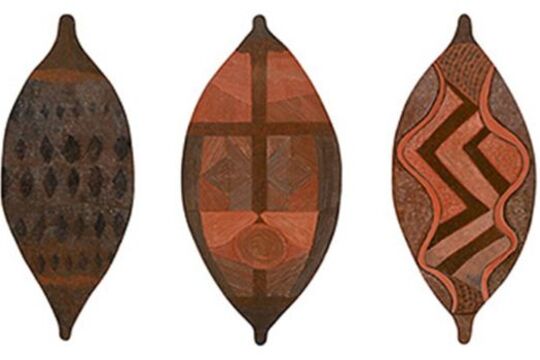
Wurundjeri elder Joy Murphy Wandin, a descendant of William Barak, discusses Barak’s experience of living at Coranderrk Aboriginal Station 1863–1903 during a time of drastic upheaval for Indigenous people in Victoria.
Further Information
TRANSCRIPT OF AUNTIE JOY MURPHY-WANDIN: CORANDERRK
Joy Murphy-Wandin: I am sitting in a beautiful spot called Badger Creek. Badger Creek was the flow on through to Coranderrk Station and Coranderrk Station is where my family lived including Barak. He was long gone when I was a child but what I’ve learnt from my parents and from those people who lived at Coranderrk was that he was a man of trust, he was a man of vigour, he was a man that would lead his people into a turmoil that needed to be resolved.
When I think about Wurundjeri country before it was settled our people were the greatest architects, engineers, orators, the greatest scientists – you could put any label on them because that’s how they survived for thousands and thousands of years. But they were regarded as still being savages and in some cases not human beings.
Coranderrk was one of the reserves set up by the government when they proclaimed the Aboriginal protection act. In my mind, and certainly in many of the people that lived there, they were not protected. First of all Wurundjeri country, with all its wonderful bush, that was totally destructed – cleared – 4850 acres of it became their new settlement.
The people that were resident at Coranderrk came from mainly Victoria and southern parts of New South Wales but they were forbidden to speak their language and the government called this the protection act. But my grandmother refused not to be able to speak her language. And at an evening, when it was prayer time she would call the women into her house and pull the little hessian curtains across the window and they would all speak their language. So in her way she was a little bit of a renegade and I hope some of that is within me.
I remember my Mum telling me about my Grandmother, when she would come into Healesville, my Uncle would bring her in on horse and cart and then on return home she would take off her best dress and her boots and run down to what people knew as the Yarra, which is the Birrarung. She needed to cleanse herself from this township – a township that had invaded her family, her culture and her heritage. And I think that Granny Jemima was possibly like my mum where you were told you do something well then you just did it and if you were treated fairly well then that was okay.
They certainly became skilled in other ways – this settlement established a bakery, a brick kiln, a school, housing. They became agriculturalists receiving the blue ribbon at the Royal Melbourne Agricultural Show for the best hops grown. They grazed cows, they had horses, there were sheep. Today much of that Coranderrk land is full of wineries.
When they brought in the half-caste act if you were able bodied and you were 35 years of age then you would have to leave the station. This of course was the start of the demise of Coranderrk. The people that were left at Coranderrk were the elderly, the sick, children and women. But not only that – about that period of time there was an excise of half of that 4850 acres and it was all because they were totally a sustainable community.
During the attempts to close Coranderrk Barak became very out spoken. A man that befriended white people so that he could know that his voice would be heard, know that the message would be heard. He became very determined and very strong willed because the force of government didn’t stop.
Barak also made friends with a wonderful Scottish woman named Anne Bon and she became the actual political advocate in parliament. She even treated Barak as a friend because they shared loss. They had both lost children and became very appreciative of one another.
I believe his heart was broken when his son Davis passed away. I think the second breaking of Barak’s heart was when he could not win the fight, when Coranderrk was closed. And of course his last fight, although he felt that the battle was over, was when he had a cut, a burn, to his hand and it wouldn’t heal. He knew that it was time for Barak to be gone.