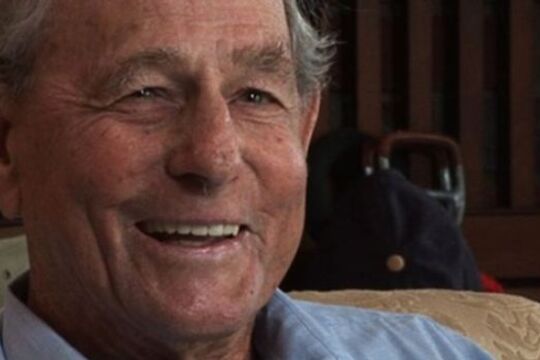
Vernon Ah Kee explores our awareness of the complexities of William Barak's art, life and position in history through the process of creating this installation.
Further Information
VIDEO TRANSCRIPT OF VERNON AH KEE: INVESTIGATING "IDEAS OF BARAK"
Vernon Ah Kee: My entry to Barak is through his artwork. I think of Barak as a drawer – his line is confident, there’s a quality to it, a sensibility which probably had a lot do with who he was and his position within his clan in the Coranderrk community.
He wanted to show ceremony, dancing, custom, the marks, he was showing action. They seem to me the equivalent of photography. These were scenes that he was making because he was there.
My involvement with the Barak project comes in three parts. The single channel video with some of my ideas about who I think he was and what I think he means to black fellas, particularly Aboriginal artists. For the second part of the project I invited a group of friends of mine – artists – just to basically have a conversation about Barak. Not just what we know of Barak and what we think he means to us and what we want him to mean to us but also getting an idea of just how unknown he is to us. The third part is a drawing and this is my idea of Barak. All portraiture is an idealised image of the subject and it’s the artist idea. So I thought I would do a drawing and drawings offer lots of opportunities for investigation and interpretation and so this is my idea.
The drawing started with my interest in Barak and wondering who he is and for me portraits provide an opportunity to find out more about that person – his physical build and his presence. Given the time he lived in it’s really fortunate there are so many images of him. That’s an indication of the calibre of his presence at Coranderrk but also but within Melbourne’s political landscape.
He seems always to be this physical, imposing and impressive presence so that was something that I could draw on. I wanted to really give the sense that he was a man of action and there was a physical presence to him and there was intensity to his thinking, there a purpose to his life and everything he did. I wanted to give a sense of that and for people to react to the drawing in that way.
It’s a big drawing – it’s 1.8 by 2.4 metres. It’s a primed acrylic canvas and I’m using compressed charcoal sticks and white conte crayon and that’s it. Charcoal for me is a medium I understand very well, I use all the time and I’m very familiar with it. My drawings are actually fairly loose - I used to draw small, very detailed drawings that were meticulous and a little pedantic. I started to draw big drawings because I didn’t want to be like that, I didn’t want to be this pedantic renderer. Drawing big affords me the opportunity to be really loose with the drawing style and still achieve a fine portrait, what people would consider to be good drawing.
Drawing on a large scale gives the opportunity to incorporate lots more detail into the face – the architecture of the face itself, the lines and the character and to draw out whatever information you can see there and to use your imagination and really see where it goes from there. When Barak starts to appear on the canvas you can start investigating his face more. The quality of the skin and the lines on his face and what his hair does and what colour his eyes were and what colour his skin was and what it felt like and the furrow in the brow and what kind of features do we want to exaggerate or find. Those are the decisions and there are hundreds and hundreds like that in every drawing. All the detail becomes much more intense and worked and rendered around the eyes because for me portraits are about the gaze.
It’s almost finished, there will be a bit more to do tomorrow but I’m pretty happy with the way it’s gone so far today.
I like to achieve an intensity that talks more about who we are as Aboriginal people today as a modern, complex and sophisticated people of emotion and hunger and persistence and anger and love and hate and all the things that all people are. Mostly Aboriginal people have a very narrow idea ascribed to them but we are just ordinary people.
I’m trying to show an idea of who I am and who I think my family is and who I think all families are through this idea of portrait but stripping away the exotic and the romantic and the primitive. Also the virtuous and the noble and all those kinds of trappings which are not necessary and do not accurately describe who we are as people.
I feel like it functions as a proper full room installation. It begins with the idea that we don’t know much about Barak and in a lot of cases we know nothing, particularly outside of Victoria. So that’s a perfect start, I think, and it’s a perfect entry into Barak - the idea of Barak as a man, as a politician, as a historical figure. I think that’s the beginning and people can ask their own questions from there.
Detail
Vernon Ah Kee: Investigating "Ideas of Barak" - A short film
Filesize: 27.0 MB
Contributor
Terms of Use
Contact the content contributor for terms of use.
Copyright
Contact the content contributor for terms of use.
Share This